Skip to content
  • Facebook
  • Twitter
  • Instagram
  • Email
NEWSX 360 : The Global News Platform

NEWSX 360 : The Global News Platform

News from across the Globe

  • Home
  • About Us
  • Terms & Conditions
  • Contact Us
  • Editor’s Note
  • Privacy Policy
  • Toggle search form
  • Redefining Fatherhood, One Hug, Lesson, And Laugh At A Time India
  • Narayana One Health Partners with dacadoo to Launch the One Health Score News
  • Mehsana Ascent Gujarati Film Kundalu bags Seven Awards at Jaipur Film Festival News
  • Cancelled Trains Between Howrah & Bhopal Restored as Durgapur Railway Work Postponed India
  • How Assam is poised to secure its Economic Growth through Energy Security! News
  • AdtU holds HR Conclave 2.0 in Guwahati; experts endorse upskilling, flexible work arrangements, and diversity and inclusion in workplace News
  • Assam will run for health and freedom News
  • ‘Iran Will Never Have Nuclear Weapons’: Trump Claims ‘Iran Broke Promise’ On Strait Of Hormuz After Peace Talks India

“Is a Mega-Tsunami Looming? US Coastal States May Have Just 10 Minutes to Evacuate”

Posted on May 20, 2025May 20, 2025 By NewsX 360 No Comments on “Is a Mega-Tsunami Looming? US Coastal States May Have Just 10 Minutes to Evacuate”

A massive earthquake along the Cascadia Subduction Zone could trigger a devastating mega-tsunami, threatening Alaska, Hawaii, and the Pacific Northwest with little warning.

Though the last major rupture occurred in 1700, researchers stress that the geological setup remains dangerously active.

A massive earthquake along the Cascadia Subduction Zone could trigger a powerful mega-tsunami. Such an event has the potential to devastate parts of the United States, particularly the Pacific Northwest, Alaska, and Hawaii, warns a recent study by Virginia Tech geoscientists, published in the Proceedings of the National Academy of Sciences. The research estimates a 15 per cent chance of a magnitude 8.0 or greater earthquake hitting the region within the next 50 years. 

Such an event could cause coastal land to sink by as much as 6.5 ft, significantly intensifying the tsunami’s destructive force. Scientists warn that the resulting waves could reach up to 1,000 ft in extreme cases, traveling miles inland and posing an unprecedented threat to millions.

Cascadia subduction zone

The Cascadia Subduction Zone is a 600-mile-long convergent fault (along tectonic plates) stretching from Northern California to Vancouver Island, Canada. It marks the boundary where the Juan de Fuca Plate is slowly sliding beneath the North American Plate — a tectonic interaction capable of producing massive “megathrust” earthquakes. 

Though the last major rupture occurred in 1700, researchers stress that the geological setup remains dangerously active. “This is a ticking time bomb,” warn scientists, noting the potential for sudden, large-scale displacement of the ocean floor — an event that could easily trigger a catastrophic tsunami.

The areas most at risk from such an event include Northern California, northern Oregon, and southern Washington. Alaska and Hawaii, while farther from the Cascadia fault line, remain vulnerable due to their seismic and volcanic profiles. 

What is a mega-tsunami?

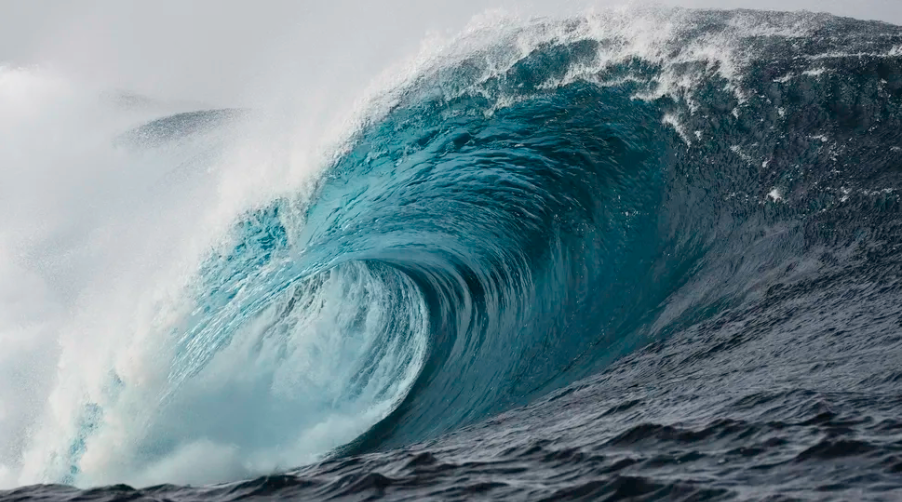
Unlike ordinary tsunamis, which typically result in waves measuring a few feet high, mega-tsunamis are characterised by extreme wave heights — sometimes hundreds of feet. These are triggered by large-scale underwater disturbances such as massive earthquakes, landslides, volcanic eruptions, or even meteorite impacts. 

Unlike regular tsunamis, mega-tsunamis can travel several miles inland with devastating force, overwhelming coastal defences and leaving very limited time for evacuation.

(A) Washington, Oregon, and California coastal estuaries analysed in this study. (B) Modelled earthquake-driven subsidence values (red rectangles) constrained by 1700 CE earthquake geologic subsidence estimates. (C) Cross-section from Necanicum River estuary showing current MHHW and 1% floodplain elevations (Photo/PNAS)

Alaska: Threatened by quakes and landslides

Alaska faces a dual threat: not only is it located on the seismically active Pacific Ring of Fire, but it is also vulnerable to landslides exacerbated by climate change. The Aleutian Islands, in particular, have a 9 per cent chance of experiencing a magnitude 9.0 or higher earthquake in the next 50 years, according to a study by the University of Hawaii at Manoa. 

Melting glaciers are also destabilising mountain slopes in Alaska, increasing the risk of massive landslides into nearby bodies of water. These landslides can displace vast amounts of water, generating tsunamis that could strike both local and distant shores.

Hawaii: Volcanic activity adds to risk

Hawaii’s volcanic topography adds another layer of danger. The Big Island’s active volcanoes, such as Kilauea, are susceptible to flank collapses — huge landslides where portions of the volcano slide into the sea. These can generate massive waves, capable of affecting not just Hawaii’s shores but other areas across the Pacific as well.

Although such events are less frequent, the dense coastal population of Hawaii makes the potential impact particularly alarming. 

Call for infrastructure resilience

The study urges immediate action to mitigate the risks posed by potential mega-tsunamis. Scientists advocate for robust early warning systems, resilient coastal infrastructure, and extensive public awareness campaigns.

In the event of a large Cascadia quake, the Federal Emergency Management Agency (FEMA) estimates the death toll could exceed 13,000, with over a million people displaced. “Evacuation times in some areas could be as little as 10 minutes,” warn experts, highlighting the urgent need for community preparedness and clear emergency protocols. 

While the study focuses on the US West Coast, the implications are global. Rising sea levels caused by climate change could increase the reach and intensity of future tsunamis. International cooperation in seismic monitoring and emergency preparedness will be essential to address the growing threat.

Related

International, USA Tags:Cascadia Subduction, National Academy of Sciences, Tsunami, USA, Virginia Tech

Post navigation

Previous Post: China’s small boat landings on Taiwan spark new security concerns
Next Post: Second man charged over fires at properties linked to UK PM Keir Starmer

Related Posts

  • HIPA signs a Memorandum of Understanding with Expo 2020 Dubai Arts
  • #BreakingNews:Indian Markets Tumble as Trump Slaps 25% Tariff on India, Effective Aug 7 International
  • Cosmetic Chemicals Market Size is Set to Reach USD 31.04 Billion by 2028: Reports and Data findings Brands
  • Second man charged over fires at properties linked to UK PM Keir Starmer International
  • US tariff unpredictability poses credit risk for debt issuers: Moody’s International
  • Capilano University and MSM conducted Agent Networking Summit in Dhaka, Bangladesh Bangladesh

Leave a Reply Cancel reply

Your email address will not be published. Required fields are marked *

  • Art of Living
  • Arts
  • Auto & Transportation
  • Automobile
  • Aviation
  • Banking
  • BCA ELECTIONS 2026
  • Bollywood
  • Brands
  • Business
  • Business Technology
  • Commodities
  • Economy
  • Education
  • Energy
  • Entertain­ment & Media
  • Entertainment
  • Entrepreneurs
  • Environment
  • Financial Services & Investing
  • Fitness
  • Gadgets
  • Health
  • Housing & Infrastructure
  • India
  • Information Technology
  • International
  • International Education
  • Investment
  • Lifestyle
  • Narendra Modi
  • News
  • People & Culture
  • Pharma
  • Policy & Public Interest
  • Politics
  • Sports
  • Stock Market
  • Tamilnadu
  • Technology
  • Telecom
  • The Multitaskers: A Series On Entrepreneurship with difference.
  • Travel
  • Uncategorized
  • UNICEF
  • Wellness
  • World News

Recent Posts

  • Cockroach Party to CEC: Quit in 48 Hours — or We Take the Fight Nationwide Over 13 Crore Deleted Voters
  • A Temple of Health and a ₹1-Lakh-Crore Bet: Bengal CM, Gautam Adani Break Ground on 2,000-Bed Arogya Mandir
  • Baroda’s Moliya Captains Rest of India U-23 for CK Nayudu Trophy Clash in Chennai
  • Modi’s Poll Chief Faces Mutiny From His Own Bench.
  • Pranav Amin Represents BCA at 95th BCCI AGM; Baroda Set to Host Major International Fixtures

Recent Comments

No comments to show.

Archives

  • September 2026
  • June 2026
  • May 2026
  • April 2026
  • March 2026
  • February 2026
  • January 2026
  • December 2025
  • November 2025
  • October 2025
  • September 2025
  • August 2025
  • July 2025
  • June 2025
  • May 2025
  • April 2025
  • March 2025
  • February 2025
  • January 2025
  • December 2024
  • November 2024
  • October 2024
  • September 2024
  • August 2024
  • July 2024
  • June 2024
  • May 2024
  • April 2024
  • March 2024
  • February 2024
  • January 2024
  • December 2023
  • November 2023
  • October 2023
  • September 2023
  • August 2023
  • July 2023
  • June 2023
  • May 2023
  • April 2023
  • March 2023
  • February 2023
  • January 2023
  • December 2022
  • November 2022
  • October 2022
  • September 2022
  • August 2022
  • July 2022
  • June 2022
  • May 2022
  • April 2022
  • October 2021
  • September 2021

  • Trezix launches Trezix One, a suite of AI assistants for smarter trade processes Brands
  • MATEXIL Honours Excellence in Exports at Annual Export Award Function in Mumbai Brands
  • Zocket Earns Great Place to Work Certification—Because Thriving Teams Build Thriving Companies Brands
  • Narayana Educational Institutions Shine Bright in JEE Main 2025 with Top Results Brands
  • IGBC certified flats in Bhopal: Why families rush to Green City Extension Brands
  • Hassle-free Home Illumination with Hafele’s Loox Furniture Lighting Brands
  • Culturist Sundeep Bhutoria to attend historic Cannes screening of restored Satyajit Ray classic Brands
  • Vedanta transforming Odisha into a global powerhouse Brands

Powered by PressBook News WordPress theme