






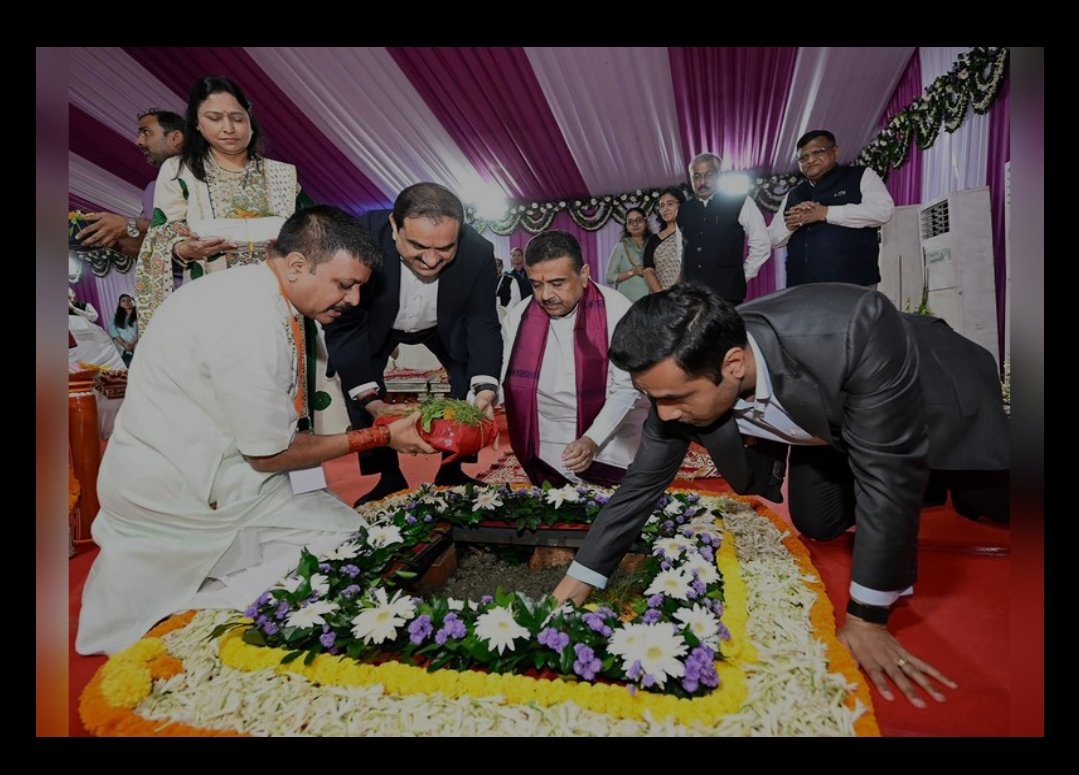
The ceremony, held on a 51.75-acre plot in Action Area 2, New Town, was also attended by Adani Foundation chairperson Priti Adani and Adani Ports managing director Karan Adani. The group and the Chief Minister performed bhumi pujan before unveiling the project plaque.
The hospital, to be executed by the Adani Foundation as a not-for-profit Academic Medical Centre, is budgeted at more than ₹4,000 crore. Officials said it is designed to treat over 200,000 inpatients and more than 2 million outpatients a year and to create about 10,000 jobs across the healthcare ecosystem.
Half the beds — 1,000 of 2,000 — will be reserved for economically weaker patients eligible under state and central health insurance schemes. The campus will combine a multi-speciality hospital with step-down and transitional care, a “Meditel” and Vishram Gruh for patients’ families, and housing for doctors and staff.
“Mr Adani, we look forward to your presence to rebuild Bengal. The final vision is not just a hospital campus, it will be a fully integrated healthcare city. Nowhere in India is there a hospital of this high standard. The hospital will give a big boost to medical tourism. This is historic, meaningful and an auspicious day for us. Viksit Bharat 2047 can happen only if Bengal develops,” Adhikari said.
Gautam Adani described the institution as world-class and not-for-profit, and compared Bengal’s role for the group in the East with Mundra’s role in Gujarat. “The Adani Arogya Mandir will be a world-class, not-for-profit medical institution that will have 2,000 beds — with a thousand beds catering to economically weaker sections of society, eligible under State and Central health insurance schemes,” he said.
He also set out a wider investment map: more than ₹1 lakh crore by 2035 in ports, logistics, renewable energy, power generation, transmission and distribution, roads and bridges, green cement and hyperscale data centres. Bengal, he said, is the group’s karmabhoomi in eastern India and a natural maritime and logistics bridge between India’s industrial heartland, the Northeast and Southeast Asia.
A campus built as a healthcare city
Phase I will focus on cancer care and advanced tertiary services. The academic wing is planned with an annual intake of 150 undergraduates, more than 100 postgraduates and over 40 super-specialists, plus a College of Nursing and an allied-health and paramedical school.
Research is meant to sit beside the wards: genomics, precision medicine, biomedical informatics, artificial intelligence, clinical trials and applied biomedical science, with an emphasis on turning lab work into diagnosis, treatment and prevention. The Foundation has engaged Mayo Clinic Global Consulting in the United States and Singapore’s SingHealth on clinical care, academic medicine, digital health, quality, workforce development and innovation.
The pitch to patients is regional as much as local. Planners say a full-spectrum destination in Kolkata should cut the flow of eastern Indian patients to other metros.
Heritage, Puja and the riverfront
The hospital was not the only paper signed on Thursday. The Adani Group inked two memorandums of understanding with the state government: one to restore the historic Writers’ Building, and another to take Kolkata’s Durga Pujas to a wider stage through “Adani Pujo Preview,” supporting organisers, artists, artisans and the festival economy.
Separately, Adani announced backing for the revitalisation of Kumartuli Ghat, the riverfront associated with the city’s idol-makers.
The Adani Foundation, the group’s social arm since 1996, says it now works in 7,247 villages across 22 states and reaches 13.3 million people in education, health, livelihoods, climate action and community development. Arogya Mandir is being framed as its largest single healthcare bet in eastern India — and as the first large industrial calling card of the Adani Group under West Bengal’s new government.