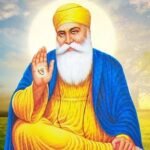

The fifteenth century was an extremely turbulent period for India. Islamic invasions from the northwest were capturing kingdoms and destroying local faiths and cultures. In such chaotic times, when the common people lived in fear, a new call of self-respect arose from the land of Punjab in the form of Guru Nanak Dev Ji. The philosophy he presented was a spiritual path that challenged foreign religious fanaticism through both thought and action. From here began the journey of the ten Gurus, which created a blazing chapter in the evolution of human civilization.
1. Guru Nanak Dev (1469–1539)
Guru Nanak Dev Ji, the founder of Sikhism, lived during the period of Babur’s invasions. When foreign invaders were destroying temples and culture, Guru Nanak raised his voice against injustice. By addressing God as ‘Akal Purakh’ (the Timeless One), he clarified that human power is temporary, and only truth is eternal. Through the principles of ‘Naam Japo’ (remember God), ‘Kirat Karo’ (earn honestly), and ‘Vand Chhako’ (share with others), he united a scattered society. His travels from Mecca–Medina to the Himalayas, known as Udasis, were not merely religious journeys but a strong ideological challenge to foreign fanaticism.
2. Guru Angad Dev (1504–1552)
Due to foreign invasions, local languages and scripts were under serious threat. Guru Angad Dev promoted the Gurmukhi script, preserving a distinct cultural identity. Recognizing that silence alone was not enough to face growing oppression, he initiated ‘Mall Akhadas’ (wrestling and training centers). Strengthening the youth physically was the first revolutionary step taken to protect faith during times of religious extremism.
3. Guru Amar Das (1479–1574)
At a time when religious fanaticism was dividing society, Guru Amar Das built a shield of social unity. By introducing the rule of ‘Pehle Pangat, Piche Sangat’ (first eat together, then meet the Guru), he eliminated social discrimination so society could remain united against oppression. He established 22 ‘Manjis’ (preaching centers), creating a strong organizational network.
4. Guru Ram Das (1534–1581)
The fourth Guru, Ram Das Ji, founded the city of Amritsar and created the sacred ‘Amrit Sarovar’. This gave Sikh tradition a global identity and became a source of new spiritual strength. To preserve a distinct cultural identity, he established the ‘Lavan’ marriage rituals. The ‘Masand’ system he initiated became a transparent means to support the needy and collect resources for community struggles.
5. Guru Arjan Dev (1563–1606)
The era of the fifth Guru, Arjan Dev Ji, marked a peak of struggle in Sikh history. Mughal emperor Jahangir viewed the growing strength of the Sikhs with hostility. Guru Arjan compiled the ‘Adi Granth’, showcasing India’s rich spiritual heritage, including the verses of saints like Namdev, Kabir, and Ravidas. When pressured to convert to Islam, Guru Arjan refused and was brutally martyred on a hot iron plate. This was the first supreme sacrifice by the Sikhs against foreign rule, blending devotion with valor.
This martyrdom marked a turning point in Indian history. Sikh tradition realized that foreign oppression could no longer be countered by peace alone; it was now time to protect wisdom with strength.
6. Guru Hargobind Singh (1595–1644)
After the martyrdom of Guru Arjan, Guru Hargobind Ji infused Sikhism with new power. He wore two swords—‘Miri’ (temporal authority) and ‘Piri’ (spiritual authority)—declaring that spirituality does not mean weakness. He established the ‘Akal Takht’ at Amritsar, which became the supreme center of justice and resistance against tyranny. He built a disciplined Sikh army and defeated Mughal forces in several battles.
7. Guru Har Rai (1630–1661)
Guru Har Rai Ji further strengthened the military organization built by the sixth Guru. When Mughal prince Dara Shikoh sought refuge during internal Mughal conflicts, Guru Har Rai supported him—an act of courage against Mughal fanaticism.
8. Guru Har Krishan (1656–1664)
After Guru Har Rai, his younger son Guru Har Krishan Ji ascended the Guruship at the tender age of five and was known as the ‘Child Guru’. During a severe smallpox epidemic in Delhi, he served the sick selflessly and sacrificed his life at the age of eight.
9. Guru Tegh Bahadur (1621–1675)
When Kashmiri Pandits faced forced conversions under Mughal emperor Aurangzeb, Guru Tegh Bahadur Ji stood firmly by them. His martyrdom in Chandni Chowk, Delhi, for religious freedom awakened national self-respect. He is honored as ‘Hind Di Chadar’—the protector of Hindu faith.
10. Guru Gobind Singh (1666–1708)
The tenth Guru, Gobind Singh Ji, represented the pinnacle of courage and leadership. In 1699, he established the Khalsa Panth, creating a disciplined armed order committed to ending Mughal tyranny. By choosing the ‘Panj Pyare’, he eradicated caste discrimination and gave Sikhs the surnames ‘Singh’ and ‘Kaur’. He mandated the five ‘Kakkars’—Kesh, Kangha, Kara, Kachera, and Kirpan. Despite sacrificing all four of his sons, he continued to fight injustice. Through the ‘Zafarnama’, he morally confronted Aurangzeb.
Guru Granth Sahib: The Eternal Guru
In Nanded, Guru Gobind Singh Ji declared that there would be no human Guru after him. He bestowed Guruship upon the Adi Granth, naming it Guru Granth Sahib, the eternal and living Guru of the Sikhs. This sacred scripture includes the teachings of saints like Namdev, Kabir, and Ravidas, and continues to guide humanity on the path of equality, service, and fearlessness. The seed of humanity sown by Guru Nanak matured into a vast tree by Guru Gobind Singh’s time, whose shade still offers peace and unity to the world.